Indoor air quality plays a fundamental role in maintaining health, comfort, and operational efficiency across modern commercial facilities. From corporate office buildings and healthcare facilities to manufacturing plants and educational institutions, airborne contaminants can degrade indoor environments rapidly if left unmanaged. Dust, pollen, mold spores, bacteria, and volatile organic compounds constantly circulate through mechanical ventilation networks. Selecting appropriate filtration equipment ensures that your building maintains compliance with health standards while protecting sensitive electronics and heavy machinery from dust accumulation. Partnering with a professional provider of commercial HVAC services allows facility managers to evaluate airflow dynamics, balance system resistance, and deploy filtration strategies optimized for their specific physical layouts. Taking a proactive approach to indoor air management creates a healthier, more comfortable environment for employees and visitors alike.
Establishing high air filtration standards also reflects a strong corporate commitment to health and environmental responsibility.
Demystifying MERV Ratings
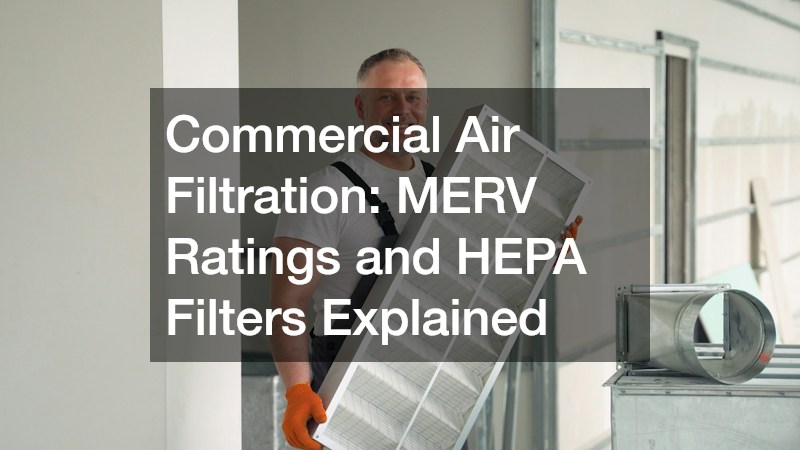
Minimum Efficiency Reporting Value, commonly abbreviated as MERV, is the industry-standard scale used to rate the effectiveness of air filters. Standardized by ASHRAE, the MERV scale ranges from 1 to 16 for standard commercial installations, measuring a filter’s ability to capture airborne particles between 0.3 and 10 microns in size. Lower-rated filters, ranging from MERV 1 to 4, capture large debris such as carpet fibers and lint, serving primarily to protect mechanical components rather than improve air quality. Filters rated MERV 8 to 12 are widely used in commercial office spaces, effectively capturing fine dust, mold spores, and dust mite debris. Higher tiers, such as MERV 13 to 16, trap microscopic particles including bacteria, smoke, and droplet nuclei carrying viruses, making them essential for high-density workspaces and modern healthcare environments. Selecting the correct MERV rating ensures optimal air purification without placing unnecessary mechanical stress on your blowers. Regularly evaluating filter ratings helps facility managers stay ahead of evolving indoor air quality standards.
The Role of HEPA Filtration in Commercial Spaces
High-Efficiency Particulate Air (HEPA) filters represent the top tier of mechanical air filtration technology, operating far beyond standard MERV testing scales. To achieve a true HEPA designation under federal standards, a filter must capture at least 99.97% of airborne particles as small as 0.3 microns. These ultra-dense filters utilize complex mats of randomly arranged glass fibers to trap microscopic contaminants through direct interception, impaction, and diffusion mechanisms. HEPA units are vital in environments where pristine air quality is non-negotiable, such as medical operating rooms, pharmaceutical compounding labs, microelectronics manufacturing cleanrooms, and isolation wards. Implementing specialized HEPA equipment through expert HVAC services guarantees maximum particle containment for critical facilities. Utilizing these advanced filtration systems provides peace of mind when regulatory compliance and sterile environments are top priorities. Integrating high-grade HEPA filters creates an impenetrable shield against tiny contaminants that standard media easily miss.
Balancing Filtration Efficiency and Airflow Resistance
While higher-efficiency filters capture a greater percentage of airborne pollutants, they also create greater resistance to airflow, known in the industry as static pressure drop. Air handlers and blower fans must work significantly harder to push air through dense filter media, which can increase electrical consumption if the system is not designed to handle the load. Installing high-efficiency MERV 13+ or HEPA filters in a system originally engineered for basic MERV 8 panels can restrict airflow, causing evaporator coils to freeze, compressors to overheat, and utility bills to spike. Facility managers must carefully balance particle capture efficiency with fan capacity, ensuring that mechanical blowers operate within safe static pressure parameters while maintaining required air exchange rates. Consulting with engineering experts prevents unnecessary wear and tear while keeping monthly utility costs fully optimized. Proper pressure monitoring prevents hidden system strain and ensures continuous operational longevity.
Designing a Tailored Filtration Strategy

Every commercial structure presents unique environmental demands, requiring a tailored approach to filter selection rather than a one-size-fits-all solution. A multi-stage filtration design is frequently the most cost-effective strategy for heavy-duty commercial applications. In these multi-stage configurations, low-cost pre-filters (typically MERV 8) capture coarse dust and large debris first, protecting and extending the operational lifespan of more expensive downstream MERV 14 or HEPA secondary filters. Regular inspection and replacement schedules are equally critical, as dirty, overloaded filters restrict airflow and lose structural integrity over time. Scheduling routine audits with licensed providers of HVAC services ensures that filter media is replaced at optimal intervals, preserving air purity and mechanical reliability year-round. Adopting structured maintenance intervals eliminates unexpected filter blowouts and keeps system performance consistent across demanding seasons.
Elevating Workplace Health and System Longevity
Investing in appropriate commercial air filtration yields substantial benefits that extend far beyond regulatory compliance. Clean indoor air reduces occupant exposure to allergens and respiratory irritants, contributing to lower absenteeism, improved cognitive performance, and greater overall workplace satisfaction. Simultaneously, clean ductwork and dust-free cooling coils maintain peak heat transfer efficiency, reducing wear and tear on expensive internal compressors and blowers. By understanding the practical distinctions between MERV scales and HEPA standards, facility leaders can make informed capital decisions that safeguard building infrastructure and prioritize human health. Implementing a well-engineered air filtration plan establishes a solid foundation for long-term operational success and sustainable facility management. Prioritizing ongoing maintenance protects both your equipment investments and the well-being of everyone inside your building. Ultimately, modern filtration solutions represent a smart financial investment that pays compounding dividends in employee health and system durability.